
War Photographer Gear Guide 2026: Cameras, Lenses and Safety
Some links on this site are affiliate links, including Amazon Associates and other affiliate programs. If you buy through them, PhotoCultivator may earn a commission at no extra cost to you. As an Amazon Associate I earn from qualifying purchases.
Updated: May 22, 2026
War photography comes down to three things: reliability, safety, and a clean workflow under pressure. The gear matters far less than having the right system.
This guide brings together practical loadouts, PPE you can verify, power/data practices that won’t fail you, and simple settings that work.
For comprehensive safety resources and training requirements, consult the Committee to Protect Journalists Safety Kit and IWMF HEFAT Training Programs.
TL;DR: Practical Loadouts (prices approximate as of Jan 2026; vary by region and condition)
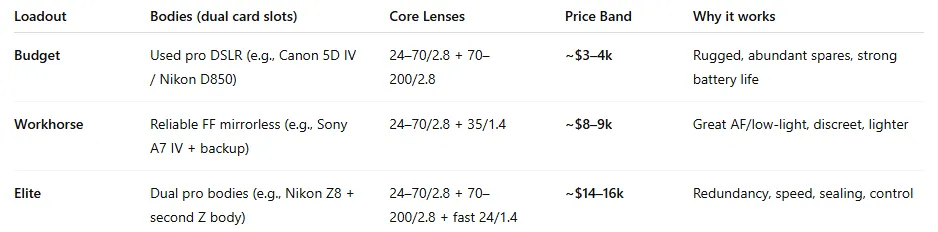
Prioritize dual card slots, weather sealing, dependable AF, and ergonomics you can run with; these trump marginal sensor gains.
If you’re weighing systems, my DSLR vs mirrorless comparison covers the real-world trade-offs for field work.
Lens Recommendations
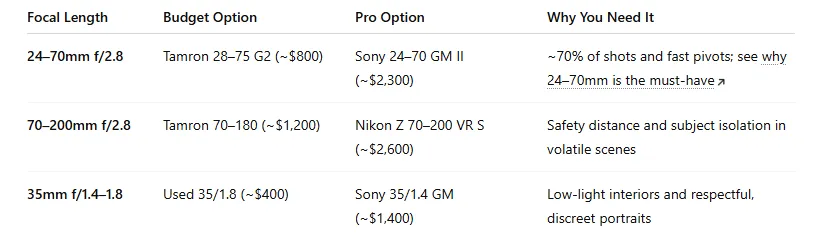
The 24-70mm f/2.8 serves as your anchor lens for most assignments; my dedicated guide on why the 24-70mm is essential for photographers explains the focal length versatility in detail.
Quick Answers (People Ask)
Mirrorless or DSLR for conflict work?
Either works if it’s reliable, weather-sealed, and has dual card slots.
Mirrorless wins on autofocus performance (eye/subject tracking) and silent shooting. DSLRs win on battery life (2-3× longer) and optical viewfinder clarity in harsh light. Many working photographers carry both.
See my DSLR vs mirrorless guide for detailed field comparisons.
How many batteries and cards per day?
Mirrorless: Plan for 8+ OEM batteries per body, especially in cold weather.
Real-world usage: 200-300 shots per battery in winter conditions. Carry 6–8 memory cards minimum and use dual-slot redundant write; never format until you have three verified copies (cards + SSD #1 + SSD #2 stored separately).
How much does war photography equipment cost?
Expect $3,000–$16,000 depending on kit level:
- Budget DSLR setup: ~$3,500
- Professional mirrorless kit: ~$8,500
- Elite dual-body system: ~$15,000+
These ranges include bodies, lenses, safety gear, and essential accessories. Check current photography gear deals before major purchases.
What camera settings for conflict zones?
Use these starting points for camera settings in conflict zones.
I provide copy-and-paste starting points for night shelling, indoor portraits, checkpoints, aftermath documentation, and low-profile street work.
Adjust based on specific light and movement conditions.
For conflict photographers who also cover motorsport, protests, or fast-moving events, the same principles apply. Read themotorsport photography guide for settings that carry over directly.
Do I need insurance for war photography?
Yes—absolutely essential. Medical evacuation coverage and equipment insurance are non-negotiable. Most major news organizations require proof of coverage before accreditation.
My photography insurance guide covers policy requirements and common exclusions to avoid.
Which body armor level should I use?
Choose PPE via written risk assessment + organizational policy + local law, not blanket rules.
IIIA soft armor stops handgun rounds and is appropriate for civil unrest and protest coverage.
Level III/IV hard plates provide rifle protection for active conflict zones. Review the NIJ Body Armor Standards for current protection level definitions and test threats.
For a complete breakdown of body armour, helmets, trauma kits, and contingency planning, read the full protective gear guide for photographers in hostile environments.
Representative Camera Options (2024–2026)
Specs vary by firmware and region; consult manufacturer pages for current details.
Sony A7 IV (full-frame mirrorless)
Balanced choice for low-profile reportage: 33MP sensor, ~10 fps continuous shooting, dual card slots (SD + CFexpress Type A), USB-C PD charging. CIPA battery life ~580 shots (LCD mode); practical for extended days with power bank support.
Popular among wire service photographers for its combination of resolution, speed, and autofocus performance. DPReview Sony A7 IV Specifications
Nikon Z8 (pro mirrorless body)
Z9-class performance in a more portable package: 45.7MP stacked sensor, 20fps blackout-free shooting, dual slots (CFexpress Type B + SD), professional weather sealing.
Used by photographers like Lynsey Addario for Ukraine assignments. Weight: 910g vs. Z9’s 1,340g. Nikon Z8 Official Specifications
Canon EOS R6 Mark II (value-forward full-frame)
Strong AF and speed at friendlier price point: 24MP sensor, 40fps electronic shutter, dual UHS-II SD slots, in-body stabilization.
CIPA battery life ~760 shots (LCD) / ~450 shots (EVF) per Canon specifications.
Excellent high-ISO performance for unpredictable lighting. Canon R6 Mark II Specifications
Tip: Quote official CIPA battery figures for planning; real-world use can exceed them in optimal conditions, but don’t base mission logistics on best-case scenarios.
Mirrorless vs DSLR (one-screen comparison)
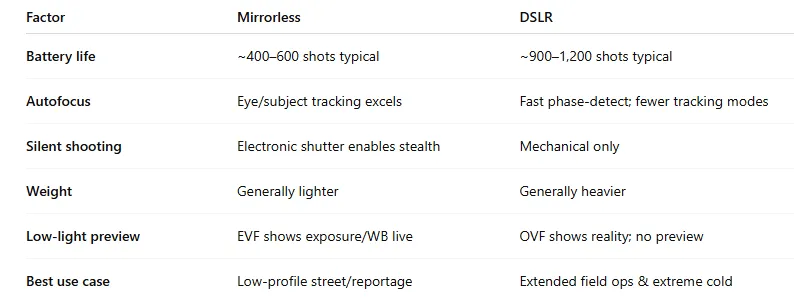
For deeper analysis, including adapter compatibility, lens ecosystems, and extreme weather performance, see my comprehensive DSLR vs mirrorless guide.
Lenses That Cover ~90% of Assignments
24–70mm f/2.8: Your Do-Everything Zoom
This is your anchor lens: context shots, environmental portraits, fast scene pivots, and street documentation.
Professional f/2.8 aperture provides sufficient light gathering for most situations while maintaining reasonable depth of field. Weather-sealed construction and fast autofocus are standard across manufacturer options (Sony GM II, Nikon Z 24-70 S, Canon RF 24-70 L).
Budget alternative: Tamron 28-75mm f/2.8 G2 delivers 90% of the performance at 40% of the price (~$800 vs. ~$2,300).
70–200mm f/2.8: Safety Distance Lens
Essential for maintaining a standoff from volatile situations while capturing telephoto compression.
The 200mm reach is often the difference between safety and danger; it allows you to document frontline action without entering immediate threat zones.
All professional 70-200/2.8 options include weather sealing and image stabilization (VR/OSS/IS).
35mm f/1.4 or f/1.8: Low-Light Specialist
Fast 35mm primes excel in three critical scenarios: indoor documentation when flash draws unwanted attention, refugee shelters and humanitarian work requiring discretion, and night assignments where higher ISOs would produce unusable noise.
The f/1.4 aperture provides a 2-stop advantage over your 24-70/2.8 zoom, meaning ISO 3200 instead of ISO 12,800: the difference between clean files and grainy, artifact-filled images.
Optional Additions Worth Their Weight
- 24mm f/1.4: Tight interiors, cramped shelters, extreme low-light night work
- 85mm f/1.8: Calmer portrait sessions, interviews, situations with time for deliberate composition
If you are deciding between mirrorless systems for field work, read the Sony vs Canon mirrorless comparison for a breakdown of how the main systems compare under real shooting conditions.
Safety & PPE You Can Verify (NIJ Levels)
Choose armor through written risk assessment + organizational policy + local import/export law, not blanket recommendations.
NIJ Protection Levels (U.S. Standards)
Level IIIA (Soft Armor)
- Protection: Handgun rounds (.357 SIG, .44 Magnum, 9mm) and shrapnel
- Weight: 5-8 lbs
- Advantages: Concealable under clothing, maintains full mobility, comfortable for extended wear
- Appropriate for: Civil unrest, protests, general assignment photojournalism
Level III (Hard Plates)
- Protection: Most rifle rounds (AR-15, AK-47, M4) non-armor piercing
- Weight: 15-20 lbs with carrier
- Advantages: Rifle protection, knife resistant
- Considerations: Heavier, restricts movement, significant heat retention in warm climates
Level IV (Hard Plates)
- Protection: Maximum ballistic protection including armor-piercing rounds
- Weight: 20-25 lbs full system
- Appropriate for: Frontline war zone coverage, active combat documentation
- Considerations: Heaviest option, major mobility restriction, rapid fatigue in hot weather
For current NIJ standards, threat level definitions, and test protocols, review the official NIJ Body Armor Standard 0101.07.
Ballistic Helmets
Bump helmets ($150-300) protect against falling debris and blunt force trauma but offer no ballistic protection, appropriate for protest coverage where projectiles are the primary concern.
Ballistic helmets ($400-800) rated NIJ Level IIIA stop handgun rounds and shrapnel. Essential for frontline work. Ensure proper fit, suspension comfort, and compatibility with eye protection and hearing protection.
IFAK (Individual First Aid Kit) Essentials
Minimum contents for conflict zone work ($75-150):
- CAT or SOF-T tourniquet (stops life-threatening extremity bleeding)
- Hemostatic gauze (QuikClot or Celox for severe wounds)
- Chest seals (vented, for penetrating chest wounds)
- Pressure bandages
- Nasopharyngeal airway
- Trauma shears
- Nitrile gloves
- Hypothermia blanket
Critical: Equipment is useless without training. Complete “Stop the Bleed” course minimum (free, 90 minutes). Full HEFAT training includes comprehensive battlefield trauma care.
HEFAT Training, Insurance & Duty of Care
Hostile Environment Training
HEFAT (Hostile Environment & First Aid Training) is the single best investment before any conflict assignment. Training costs $1,500-3,500 for 3-5 day courses and covers:
- Risk assessment and threat detection
- Situational awareness in hostile environments
- Trauma first aid and emergency medical response
- Crisis management and de-escalation
- Digital security and communication protocols
- Kidnap survival and negotiation basics
- Mine and UXO (unexploded ordnance) awareness
Major providers:
- Objective Travel Safety (UK/EU): Trains BBC, ARD, NOS journalists
- First Option/IMSG (US): Pennsylvania-based, endorsed by INSI and Rory Peck Trust
- GJS Security (UK): Customized courses for photography organizations
Start with the IWMF HEFAT overview to understand requirements and compare providers.
Refresher requirements: Most news organizations require HEFAT refreshers every 2-3 years. Skills degrade; training saves lives.
Insurance Requirements
Medical/Evacuation:
- International SOS: Medical evacuation from conflict zones ($500-800/year)
- Global Rescue: Emergency extraction services ($300-500/year)
- K&R (Kidnap & Ransom): Required by many news organizations for high-risk assignments
Equipment Coverage:
- World Nomads: Photography equipment in high-risk areas (up to $10,000)
- TCP (The Camera Protection): War zone equipment coverage
- Professional liability: Injury to others in a professional capacity
For detailed policy comparisons and common exclusions, see my photography insurance guide.
Risk Assessment
Before deployment, complete a written risk assessment with your editor/fixer covering:
- Threat level analysis (kinetic, chemical, medical, political)
- Communication plan (check-in schedule, emergency contacts)
- Evacuation routes and rally points
- Local hospital locations and capabilities
- Embassy contact information
- Legal considerations (visa, accreditation, permissions)
Consult the CPJ Safety Kit for baseline safety guidance and checklists.
Power & Data Workflow (what fails first)
Power Planning
Mirrorless shooters:
- Minimum 8 OEM batteries per camera body
- USB-C PD power bank (25,000mAh, 145W output)
- 12V car adapter for charging during transport
- Compact folding solar panel for multi-day remote assignments (Goal Zero Nomad 20)
Battery reality: CIPA ratings show typical performance, but cold weather reduces capacity 40-50%. Keep spare batteries in inside jacket pockets where body heat maintains charge.
DSLR advantage: Canon 5D Mark IV and Nikon D850 deliver 900-1,200 shots per charge, 2-3× longer than mirrorless. This is why many working photographers still carry at least one DSLR body for extended field operations.
In-Camera Redundancy
Always use dual-slot redundant write:
- Both cards record identical files simultaneously
- If one card fails, you have complete backup
- Memory card failure is common in harsh environments (dust, heat, moisture)
- Never delete in-camera
- Format only after verified backups to multiple locations
Card selection:
- SD cards: SanDisk Extreme PRO UHS-II V60 or faster
- CFexpress Type B: SanDisk Extreme PRO (for Nikon Z8/Z9)
- Minimum 128GB per card; 256GB preferred
- Carry 6-8 cards total
Nightly Backup Workflow (Non-Negotiable)
- Primary backup: Checksum copy all cards → Portable SSD #1
- Keep cards as second master: Do not format until back home with third backup
- Secondary backup: Mirror SSD #1 → SSD #2
- Separate storage: Keep SSD #2 physically separate from camera bag (hotel safe, different vehicle, trusted colleague)
- Cloud upload: When bandwidth allows, upload priority images to editorial FTP or secure cloud storage
Why this works: Three copies (cards + SSD #1 + SSD #2) in two locations protects against equipment loss, theft, or destruction.
Hardware:
- SanDisk Extreme Portable SSD 2TB ($160 each): Ruggedized, IP55 dust/water resistant
- Samsung T7 2TB ($140): Slightly less rugged but reliable
Security Protocols
Encryption:
- VeraCrypt: Free, open-source full disk encryption for SSDs
- BitLocker (Windows) or FileVault (Mac): Built-in laptop encryption
- VPN (ExpressVPN, NordVPN): Encrypt transmissions from hotels/cafes
Metadata management:
- Scrub EXIF/GPS data when it could expose civilian or military positions
- ExifTool (free) for batch metadata removal
- Keep private log of original metadata for your records
- Some editorial clients require GPS coordinates; check policy before removal
Chain of custody log:
Simple text file documenting: date/time captured, location, subject, access history. Critical if images become evidence in war crimes investigations.
Authenticity & Provenance
Content Credentials (C2PA) provides cryptographic proof of capture device, time, location, and tamper-evident edit history. Adobe, Nikon, Sony, and Canon are implementing C2PA across cameras and software.
Learn more at Content Authenticity Initiative.
Best practice:
- Enable in-camera Content Credentials if available (newer cameras)
- Use Adobe Lightroom/Photoshop with Content Credentials enabled
- Attach credentials at export before sending to editors
- Always keep unedited RAW files as proof of authenticity
Scenario-Based Starting Settings (copy & adapt)
Night Shelling (Distant)
Settings: 1/250–1/500s - f/2.8–4 - ISO 3200–12,800 - AF-C - Continuous High burst
Lens: 70-200mm f/2.8 for safety distance
Why: Fast shutter freezes explosions and tracer fire; high ISO necessary for available light only
Indoor Shelter Portraits
Settings: 1/125s - f/1.8–2.8 - ISO 800–3,200 - AF-S - Silent shutter
Lens: 35mm f/1.4 for low-light capability and environmental context
Why: Wide aperture for available light; silent shutter respects quiet space
Checkpoint / Fast-Moving Action
Settings: 1/1000s - f/2.8–5.6 - Auto-ISO 400–6,400 - AF-C - Back-button focus
Lens: 24-70mm f/2.8 for versatility
Why: Fast shutter freezes movement; auto-ISO adapts to changing conditions
Aftermath Daylight Documentation
Settings: 1/250s - f/5.6–8 - ISO 200–800 - AF-S - CPL optional
Lens: 24-70mm f/2.8
Why: Stopped-down aperture maximizes depth of field; low ISO for clean files
Low-Profile Street Reportage
Settings: 1/250s - f/2–2.8 - ISO 800–3,200 - AF-C (eye detection) - Silent shutter
Lens: 35mm f/1.4 for discreet shooting
Why: Silent shutter prevents drawing attention; eye AF tracks subjects
Packing List & Weight Targets (realistic)
Primary Camera Bag (~12-15 lbs)
- Two bodies (dual card slots)
- 24-70mm f/2.8
- 70-200mm f/2.8
- Fast 35mm
- 8+ batteries
- USB-C PD power bank (24,000mAh)
- 12V car charger
- 6-10 memory cards
- 2× 2TB rugged SSD
- Lens cleaning kit
- Rain covers
- Gaffer tape, microfiber cloths
Safety Gear (~20-30 lbs, worn or secondary bag)
- NIJ-rated vest/plates (per risk assessment)
- Ballistic helmet (Level IIIA)
- Ballistic eye protection
- Hearing protection
- IFAK (Individual First Aid Kit)
Communication & Navigation (~1-2 lbs)
- Local SIM + eSIM phone
- Satellite messenger (Garmin inReach Mini 2)
- Backup phone
- Analog map
- Headlamp with red filter
Documents & Essentials
- Passport (waterproof case)
- Press accreditation
- Insurance documents
- Emergency contact card
- Fixer contact details
- Cash (USD + local currency)
Clothing & Personal (~4-6 lbs)
- Neutral-colored clothing (avoid military patterns)
- Weatherproof shell jacket
- Broken-in boots
- Thin liner gloves (camera-operable)
- Neutral-color hat/cap
Total weight:
- Without body armor: ~18-23 lbs (manageable for extended periods)
- With Level III/IV armor: ~38-53 lbs (plan for fatigue, hydration, rest cycles)
Accreditation & Fixers (Ukraine)
Official Accreditation Process
For frontline reporting in Ukraine, follow the official Armed Forces of Ukraine accreditation process. As of January 2026 (verify before you go), requirements include:
- Application through Ministry of Defense Ukraine portal
- Passport copy and press credentials from recognized news organization
- Background verification (2-4 weeks typical)
- HEFAT training certificate (often required or strongly recommended)
- Insurance confirmation (medical evacuation coverage)
- Signed liability waiver
Important: Read Commander-in-Chief Order No. 73 governing media activity under martial law. Military commanders retain authority to deny access to specific areas based on operational security.
Working with Fixers
Professional fixers provide essential services:
- Local knowledge and real-time situational awareness
- Translation and cultural mediation
- Access to sources and restricted locations
- Transportation and logistics
- Threat assessment and security advice
- Emergency support
Compensation: Professional fixers typically charge $150-300/day plus expenses. This is not an area to cut costs; experienced fixers save lives.
Vetting process:
- Request references from other journalists who’ve worked in the region
- Verify experience in conflict zones (not just general guiding)
- Confirm appropriate local contacts (security, medical, government)
- Ensure reliable vehicle and communication equipment
- Discuss risk tolerance and boundaries before engagement
Ethics & Consent (fast, serious, non-negotiable)
Research note: Academic work on Ukraine war images published in Frontiers in Political Science identifies distinct empathy patterns in audience response, useful context for ethical decision-making and edit choices.
Informed Consent
When possible, obtain verbal consent:
- Explain who you are and your organization
- Describe how images will be used and where published
- Understand that many situations don’t allow formal consent (active combat, public events)
- Consider whether the subject understands the potential impact
Special care required:
- Children and minors (guardian consent when possible)
- Vulnerable populations (refugees, injured, displaced persons)
- Medical situations (respect dignity, avoid gratuitous suffering)
- Dead bodies (weigh public interest against family dignity)
For a comprehensive ethical framework, see our guide on photographers’ ethical obligations to subjects.
Protecting Subject Safety
Avoid identifiable details that could endanger subjects:
- Blur faces when subjects could face retaliation
- Scrub GPS metadata from images showing refugee locations, resistance fighters, and activists
- Consider delayed publication if immediate release increases risk
- Coordinate with subjects on timing and distribution when possible
Image Manipulation Boundaries
Editorial standards generally allow:
- Cropping to improve composition
- Basic exposure and contrast adjustment
- Color correction to match the scene as witnessed
- Dust spot removal
- Lens distortion correction
Strictly forbidden:
- Adding, removing, or moving elements
- Compositing multiple frames (except clearly labeled photo illustrations)
- Altering content to change meaning
- Cloning out distracting elements beyond dust spots
Always maintain unedited RAW files as proof of authenticity and defense against manipulation accusations.
Cultural Sensitivity
Research before shooting:
- Local customs regarding photography (religious sites, gender considerations)
- Political complexities and historical context
- Symbols, gestures, and clothing with political meaning
- Avoid inadvertent propaganda serving one side’s narrative
- Respect the dignity of subjects even in extreme circumstances
Trauma-Informed Approach
Recognize your impact:
- Your presence affects traumatized people
- Avoid re-traumatization through aggressive shooting
- Know when to lower the camera and offer human support
- Some moments should remain private
- Seek permission before photographing dead bodies when circumstances allow
Your psychological safety: Conflict photography causes secondary trauma. Research published in Psychosomatic Medicine analyzing 684 conflict journalists over 18 years found a 28.6% lifetime PTSD prevalence rate, significantly higher than the general population.
The study revealed that symptoms are dominated by reexperiencing/intrusion, with female photojournalists and those with frequent exposure to graphic violence at elevated risk.
Many photographers develop PTSD, but only 11% reported that their employers advised them of the potential emotional impact, and just 25% were offered counseling despite regular trauma exposure.
This lack of institutional support amplifies risk for freelancers who lack organizational resources. Seek professional mental health support proactively, not just in crisis.
Real-World Kit Notes (Working Photographers)
Lynsey Addario (Nikon Z-Series)
Long-time Nikon shooter who transitioned to Z-series mirrorless for recent Ukraine assignments.
Favors 24-70mm f/2.8 and 35mm f/1.4 for versatility and low-light performance. Emphasizes reliability and familiarity over chasing latest specifications; knows her gear intimately and can operate instinctively under stress. Nikon interview with Lynsey Addario
Key insight: “I need equipment I can trust completely. When you have seconds to capture something, you can’t be fumbling with new gear.”
Jonathan Alpeyrie (Minimalist Canon Setup)
Recent gear profiles show emphasis on mobility: main body with 24-70mm f/2.8, spare body with 50mm f/1.2 for low-light work, and Level III body armor.
Total weight ~35 lbs including armor. Prioritizes movement capability over comprehensive lens selection. PetaPixel: War Photographer’s Camera Bag
Key insight: “Every pound matters when carrying armor in hot weather. I’ve stripped my kit to only what I use 95% of the time.”
Maxim Dondyuk (Long-Term Ukraine Projects)
B&H Photo Podcast and interviews stress building trust with subjects over time, returning to same locations repeatedly, understanding broader political and historical context beyond dramatic moments. Spotify: B&H Photo Podcast with Maxim Dondyuk
His perspective: “War is not an excuse for censorship. It’s about documenting truth under the most challenging circumstances. But truth requires context, time, and understanding—not just dramatic pictures.”
FAQ
Mirrorless or DSLR for conflict zones?
Either works if reliable, weather-sealed, and dual-slot. Mirrorless wins on AF/silence; DSLRs on stamina. Mix if weight budget allows. See DSLR vs mirrorless guide for detailed field comparisons.
How many batteries and cards per day?
Mirrorless: plan 8+ OEM batteries per body in cold/long days. Carry 6-8 cards and don’t format until you hold 3 copies (cards + SSD1 + SSD2 stored separately).
What NIJ level should I consider?
IIIA (soft) for civil unrest and non-rifle contexts; III/IV plates when rifle threats are credible risk. Decide via written risk assessment and organizational policy. Review NIJ 0101.07 standards.
Do I need a ballistic helmet?
For frontline work, ballistic IIIA helmets are common PPE. Ensure proper fit and compatibility with eyewear/hearing protection. Bump helmets (no ballistic rating) sufficient for protest coverage.
How do I prove image authenticity?
Adopt Content Credentials (C2PA) in-camera or at export; support expanding across Adobe tools and hosting platforms. Keep unedited RAWs. Content Authenticity Initiative
Where do I start for Ukraine accreditation?
Ministry of Defense accreditation page: review Order No. 73 for rules under martial law.
Which lenses should I prioritize?
Start with 24-70mm f/2.8 (your most-used lens), add 70-200mm f/2.8 for safety distance, then fast 35mm for low-light work. My 24-70mm guide explains the focal length versatility.
Do I need conflict photography insurance?
Yes: medical evacuation and equipment coverage are essential. Most news organizations require proof before accreditation. See photography insurance guide for policy requirements.
Disclaimer & Duty of Care
This guide is informational, not operational or medical advice.
Conflict reporting is inherently dangerous, and conditions change rapidly. Always defer to your organization’s security team, local laws, and formal risk assessment. Complete HEFAT training before any deployment. Review CPJ Safety Resources and IWMF HEFAT programs before entering conflict zones.
The author and PhotoCultivator assume no liability for injuries, equipment loss, or other consequences. Your safety is your responsibility. If you have doubts about a situation, withdraw; no image is worth your life.
—Hakan Ozturk | Founder, PhotoCultivator.com