
Why pros choose 24-70mm over 18-125mm (it's not what you think)
Some links on this site are affiliate links, including Amazon Associates and other affiliate programs. If you buy through them, PhotoCultivator may earn a commission at no extra cost to you. As an Amazon Associate I earn from qualifying purchases.
You’ve probably heard it a dozen times: “Get a 24-70mm lens.”
But if you’re like most photographers, you’re wondering why everyone recommends this specific focal range when an 18-125mm seems more versatile on paper.
Here’s the truth: the 24-70mm earns its reputation through results, not range.
The Real Reason Professionals Choose 24-70mm
Image Quality Beats Convenience
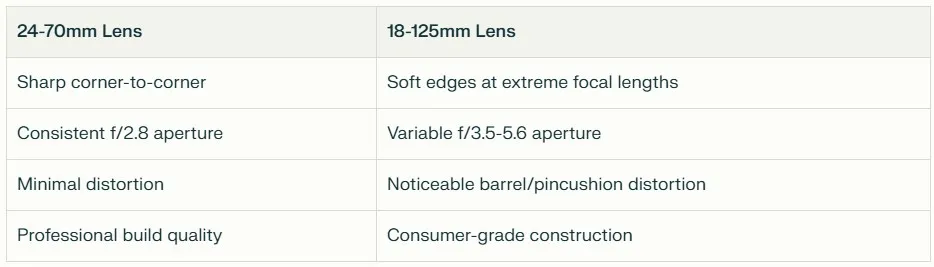
When manufacturers design a lens with a shorter zoom range, they can optimize every element for peak performance.
Compare this to longer zooms that make compromises:
The Sweet Spot Range
The 24-70mm covers exactly what you need for 80% of photography situations:
- 24mm: Group shots, landscapes, architecture
- 35mm: Street photography, environmental portraits
- 50mm: Natural perspective, general photography
- 70mm: Tight portraits, subject isolation
5 Practical Reasons to Choose 24-70mm
1. Low-Light Performance
The constant f/2.8 aperture means you can shoot in dimly lit venues without cranking up ISO.
Try shooting a wedding reception with an f/5.6 lens. You’ll quickly understand why professionals invest in faster glass.
For more techniques on handling challenging lighting conditions, check out my comprehensive guide on low-light photography tips.
2. Consistent Results
Every focal length delivers the same sharpness and color rendition. No surprises when you zoom in or out.
3. Weather Sealing
Most professional 24-70mm lenses handle rain, dust, and humidity, essential for outdoor photography.
4. Resale Value
Professional lenses hold their value better. Your 24-70mm will be worth more in 3 years than a consumer superzoom.
If you’re planning your camera investments strategically, my guide on best times to buy camera gear to save money can help maximize your budget.
5. Focus Speed
Better autofocus motors mean you won’t miss the shot when kids are running around or wildlife is moving.
Best 24-70mm Lenses by Budget
Budget-Friendly Options ($300-600)
- Canon EF-S 17-55mm f/2.8: Crop sensor equivalent, excellent value
- Tamron 28-75mm f/2.8: Third-party option with great image quality
- Sigma 24-70mm f/2.8 DG OS HSM Art: Professional features at lower cost
Mid-Range Choices ($800-1,200)
- Sony FE 24-70mm f/4 ZA OSS: Lighter weight, excellent for travel
- Nikon Z 24-70mm f/4 S: Sharp across the range, compact design
- Canon RF 24-70mm f/2.8 L IS USM: Image stabilization bonus
Professional Tier ($1,500-2,500)
- Canon EF 24-70mm f/2.8L II USM: Industry standard for reliability
- Nikon AF-S 24-70mm f/2.8E ED VR: Vibration reduction advantage
- Sony FE 24-70mm f/2.8 GM: Mirrorless perfection with fast autofocus
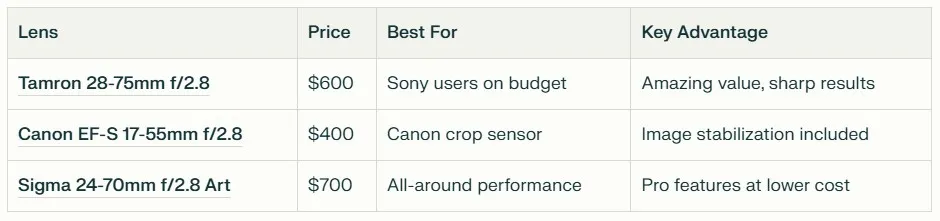
Quick Reference: My Top 3 Budget Picks
If you’re considering used gear to stretch your budget further, my used mirrorless camera buying guide offers essential tips for making smart purchases.
24-70mm vs Prime Lens Combinations
Many photographers debate whether one 24-70mm zoom beats carrying multiple prime lenses. Here’s the honest comparison:
24-70mm Zoom Advantages:
- Convenience: One lens for multiple situations
- Speed: No lens changes during fast-paced shoots
- Weather protection: Less chance of getting dust on sensor
- Cost: Often cheaper than buying 3-4 prime lenses
Prime Lens Combination (24mm + 35mm + 50mm + 85mm):
- Image quality: Primes are typically sharper
- Aperture: f/1.4-f/1.8 primes beat f/2.8 zooms for shallow depth of field
- Low light: Better performance in extreme conditions
- Weight: Individual primes are lighter (though combined weight is higher)
The Verdict:
Choose 24-70mm if you prioritize convenience and shoot events, weddings, or travel photography. For comprehensive event shooting techniques, explore my event photography tips guide.
Choose prime combinations if you prioritize ultimate image quality and have time for lens changes.
Brand-Specific Advice
Canon Users
- DSLR: Canon EF 24-70mm f/2.8L II USM is the gold standard
- Mirrorless: Canon RF 24-70mm f/2.8L IS USM adds image stabilization
- Budget pick: Canon EF-S 17-55mm f/2.8 IS USM for crop sensors
Canon Tip: The RF version has better close-focusing ability than the EF version, which is great for detail shots. For more Canon recommendations across different budgets, check out my best Canon cameras guide.
Nikon Users
- DSLR: Nikon AF-S 24-70mm f/2.8E ED VR offers vibration reduction
- Mirrorless: Nikon Z 24-70mm f/2.8 S is incredibly sharp
- Budget pick: Nikon AF-S 24-70mm f/2.8G ED (older version, still excellent)
Nikon Tip: The Z-mount version is noticeably sharper than the F-mount equivalent, especially at the edges.
Sony Users
- Full frame: Sony FE 24-70mm f/2.8 GM for professional work
- Lightweight option: Sony FE 24-70mm f/4 ZA OSS for travel
- Budget pick: Tamron 28-75mm f/2.8 Di III RXD (amazing value)
Sony Tip: The GM version’s autofocus is incredibly fast and silent, perfect for video work. For detailed Sony camera insights, read my Sony A6400 camera review.
For an in-depth comparison between major camera systems, the Sony vs Canon mirrorless comparison breaks down the key differences.
When to Consider the 18-125mm Instead
Choose the longer zoom if you:
- Travel frequently and want one lens for everything
- Are just starting out and want to explore different focal lengths
- Have a limited budget (under $500)
- Rarely print larger than 8x10 inches
If you’re new to photography and unsure about your first camera purchase, my best cameras for beginners guide can help you make the right choice from the start.
Quick Setup Tips for Your 24-70mm
For Portraits: Use 70mm at f/2.8 to blur backgrounds naturally
For Groups: Shoot at 24mm but keep people away from the frame edges to avoid distortion, then dial in the right aperture for the group size
For Events: Start at 35mm: it’s the most versatile focal length in the range
For Low Light: Don’t be afraid to use f/2.8 throughout the zoom range
For more fundamental camera operation guidance, explore my essential camera settings for beginners tutorial.
Don’t Make This 24-70mm Mistake I See Beginners Make
The biggest mistake:
Using 24mm for everything just because it’s the widest setting. I see new photographers constantly shooting at 24mm, thinking “wider is better,” but this creates unflattering distortion in portraits and makes compositions feel empty.
The fix:
Start at 35mm for most situations, then zoom out to 24mm only when you specifically need the wider perspective. Your photos will immediately look more professional.
Final Thoughts
The 24-70mm isn’t recommended because it’s trendy. It’s recommended because it delivers professional results in the situations you’ll encounter most often.
Think of it this way: Would you rather have a Swiss Army knife that does 20 things okay, or a high-quality tool that does 5 things exceptionally well?
For photographers serious about improving their craft, the 24-70mm is often the single most important lens upgrade you can make. The goal is mastering a tight set of focal lengths at the best possible image quality, not covering every option.
Whether you choose the budget-friendly Tamron, the reliable Canon workhorse, or the cutting-edge Sony GM, you’re investing in a lens that will serve you for years to come.
To complete your photography kit, consider adding some essential photography gadgets that complement your new lens perfectly.
What’s your experience with 24-70mm lenses? Hit reply and let me know what you’re shooting with. I read every email.
—Hakan | Founder, PhotoCultivator.com