
Best Budget Wildlife Cameras (2026): Top 6 Picks Under $1000 + Lens Kits
Some links on this site are affiliate links, including Amazon Associates and other affiliate programs. If you buy through them, PhotoCultivator may earn a commission at no extra cost to you. As an Amazon Associate I earn from qualifying purchases.
Quick Picks: Best Wildlife Cameras Under $1000
Every camera below is a body (or an all-in-one superzoom) that sells for under $1,000 today. Prices are current retail at the time of writing and move often, so treat them as a starting point, not a fixed quote.
| Pick | Best for | Type | Price |
|---|---|---|---|
| Nikon D3500 (used, 18-55mm kit) | Cheapest DSLR entry point | DSLR | ~$317.72 (used) |
| Canon EOS R10 (body only) | Best autofocus for moving wildlife | Mirrorless | $840.21 |
| OM System (Olympus) E-M10 Mark IV (14-42mm kit) | Stabilized mirrorless kit | Mirrorless | $899.99 |
| Nikon Coolpix P900 | Longest built-in zoom reach | Superzoom bridge | $699.99 |
| Sony HX99 | Pocketable travel zoom | Compact superzoom | $798 |
| Panasonic LUMIX FZ80D | Best backyard-birding value | Superzoom bridge | $547.99 |
Are you a complete beginner looking to start wildlife photography?
Whether you want to capture birds, reptiles, or animals at a distance, this guide will help you get started without breaking the bank. Two of these picks are interchangeable-lens cameras that you pair with a telephoto lens, and four are all-in-one superzooms that need no extra glass.
For more beginner-friendly options across every genre, see my Best Cameras for Beginners guide.
Understanding Camera Types for Beginners
Before diving into specific recommendations, here are the main camera types you will encounter:
- DSLR (Digital Single-Lens Reflex): A mirror-and-optical-viewfinder design. DSLRs are heavier, but their optical finders sip battery, so they last far longer per charge than mirrorless bodies.
- Mirrorless: Compact and lighter, with electronic viewfinders and, on recent models, faster subject-detection autofocus.
- Superzoom (bridge) cameras: A fixed lens with a very long zoom range built around a small sensor. They deliver enormous reach in one package for the price, at the cost of low-light quality.
For wildlife, two things matter most: reach (how much telephoto you can afford) and autofocus that can track a moving animal. The sections below are organized around those two needs.
Understanding Wildlife Reach on a Budget
Reach is the hardest thing to buy cheaply, so it pays to spend in the right place:
- Crop sensors stretch your lens. An APS-C body applies roughly a 1.5x crop factor (Nikon, Sony, Fujifilm) or 1.6x (Canon), and Micro Four Thirds applies 2x. A 400mm lens frames like a 640mm on a Canon APS-C body and like an 800mm on a Micro Four Thirds body. For distant birds, that free reach is often worth more than a larger sensor.
- Used bodies are the smart buy. Autofocus and burst speed matter more than the newest sensor for wildlife, and last-generation bodies handle both well. Buying a used or refurbished body frees up budget for the telephoto lens, which is where reach actually comes from.
- Superzooms trade quality for reach. A bridge camera with a 1/2.3-inch sensor can reach 1200mm to 2000mm equivalent in a single package that no interchangeable-lens kit can match at the same price. The tradeoff is a small sensor that struggles as light falls, so superzooms are strongest in daylight.
The 6 Best Budget Wildlife Cameras Under $1000
1. Nikon D3500 (Best Budget DSLR, buy used)
Current price: used, around $317.72 with the 18-55mm kit lens
Nikon has discontinued the D3500 new, so the used market is where it lives now, and that is what makes it the cheapest honest way into a proper interchangeable-lens camera.
Key specs (Nikon):
- 24.2MP APS-C sensor
- 5 fps continuous shooting
- 1080p Full HD video
- Nikon rates the battery at well over 1,000 shots per charge (CIPA), far more than a typical mirrorless body
Best for: Backyard birders and entry-level wildlife shooters who want a real optical viewfinder and long battery life.
Reach note: The 18-55mm kit lens is a walk-around lens, not a wildlife lens. Budget for a telephoto such as a 70-300mm to actually reach birds. The D3500’s 1.5x crop makes a 300mm frame like a 450mm.
Pro tip: Refurbished and used bodies from reputable sellers cut the price further.
2. Canon EOS R10 (Best Autofocus Under $1000)
Current price: Canon EOS R10, body only, $840.21
The R10 is the pick when your subjects move: its subject-detection autofocus is the most capable on this list.
Key specs (Canon):
- 24.2MP APS-C sensor
- 15 fps mechanical shooting
- Animal-detection autofocus (birds, dogs, cats)
- 4K UHD video up to 30p (60p available with a crop)
Lens pairing: Canon RF 100-400mm f/5.6-8, $699. It is the correct RF mount for the R10, and on the R10’s 1.6x crop it frames like a 160-640mm. The body plus this lens runs about $1,539, so the body is the sub-$1000 pick and the lens is the add-on that turns it into a full wildlife kit.
Limited native RF-mount telephoto choice is the main drawback, though the 100-400mm covers most wildlife needs on its own.
3. OM System (Olympus) E-M10 Mark IV (Best Stabilized Kit)
Current price: E-M10 Mark IV with 14-42mm kit lens, $899.99
Key specs (OM System / Olympus):
- 20MP Micro Four Thirds sensor
- 5-axis in-body image stabilization
- 4K video
The Micro Four Thirds system applies a 2x crop, so telephoto lenses reach twice as far as their marked focal length, a real reach-per-dollar advantage for wildlife. In-body stabilization also helps keep long-lens shots steady. As with the R10, the bundled 14-42mm is a general-purpose lens, and a telephoto is a separate purchase for serious reach.
4. Nikon Coolpix P900 (Longest Reach in One Package)
Current price: Nikon Coolpix P900, $699.99
Key specs (Nikon):
- 83x optical zoom (24-2000mm equivalent)
- 16MP 1/2.3-inch sensor
Nothing else here reaches 2000mm without a five-figure lens, which makes the P900 a favorite for distant birds and a popular choice among birders. The small sensor means it is at its best in good light.
5. Sony HX99 (Most Pocketable)
Current price: Sony HX99, $798
Key specs (Sony):
- 30x optical zoom (24-720mm equivalent)
- 18MP 1/2.3-inch sensor
The HX99 folds a 720mm-equivalent reach into a body that fits a jacket pocket, which makes it the travel and hiking pick when carrying a bigger bridge camera all day is too much.
6. Panasonic LUMIX FZ80D (Best Backyard-Birding Value)
Current price: Panasonic LUMIX FZ80D, $547.99
The FZ80D is the current version of Panasonic’s popular budget superzoom line.
Key specs (Panasonic):
- 60x optical zoom (20-1200mm equivalent)
- 4K video
Its 1200mm-equivalent reach makes it easy to photograph birds up close from across the yard, and it is the least expensive way here to get that much zoom. Like every superzoom, it favors daylight.
Cameras for Hummingbird Photography
Hummingbirds are the hardest test of a budget wildlife camera, because you need three things at once:
- A telephoto lens or long zoom (300mm equivalent or more) to fill the frame
- Fast autofocus and high burst speed to freeze rapid wing movement
- The option to switch to manual focus for precise framing at a feeder
Of the picks above, the Canon EOS R10 (pick 2) is the strongest choice here: its 15 fps burst and animal-detection autofocus suit fast wing motion, paired with the RF 100-400mm for reach. Among the superzooms, the P900 and FZ80D deliver the reach in one package, though their smaller sensors want bright light and their autofocus is slower than the R10’s.
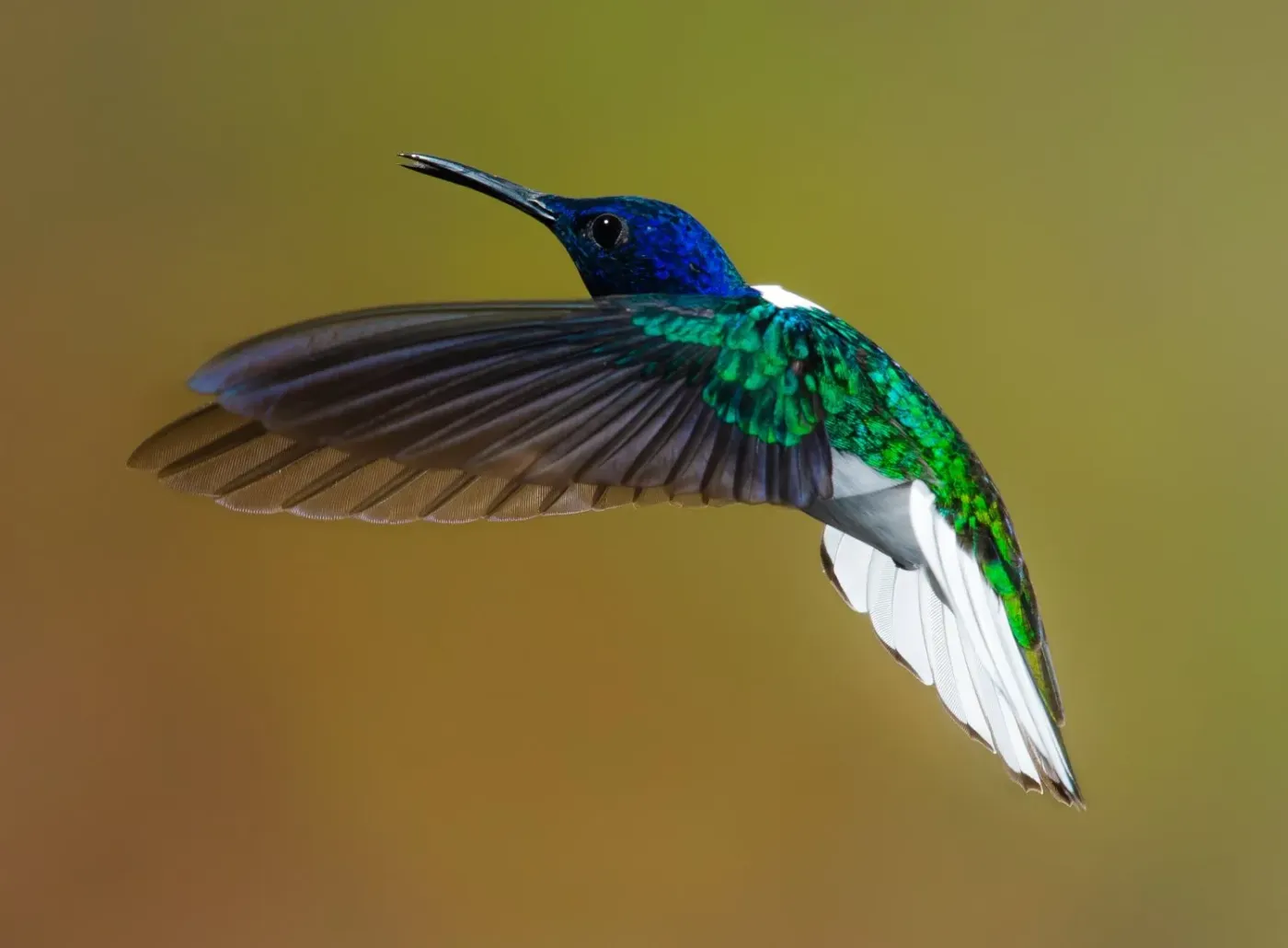 A White-necked Jacobin hummingbird hovering in mid-air.
Stretching Past $1,000: Serious Reach
The picks above stay under $1,000 per body. If your subjects are consistently far away, small songbirds or wildlife across a field, real long-lens reach costs more, and it belongs in its own budget. Here is one honest, mount-correct option that goes past the $1,000 line:
- Body: Canon EOS 90D, renewed, $1,249
- Lens: Sigma 150-600mm f/5-6.3 Contemporary DG OS HSM, Canon EF mount, used, $1,598
- Combined total: about $2,850
Key specs (Canon): the 90D is rated at 10 fps, with a 45-point all cross-type autofocus system and 4K/30p video. Its 32.5MP APS-C sensor is the highest-resolution APS-C body Canon has made.
The Sigma must be the Canon EF version to mount on the 90D. Do not substitute a Nikon-mount or 150-500mm variant. On the 90D’s 1.6x APS-C sensor, the 150-600mm frames like a 240-960mm equivalent, so 600mm gives roughly 960mm of reach. That is the kind of reach small, distant birds actually need, at a price that reflects it.
Getting Started with Wildlife Photography
As a complete beginner, here are some tips to help you get started:
- Start local: Practice in your backyard or nearby parks. This allows you to get comfortable with your equipment without traveling far.
- Learn the basics: Focus on understanding aperture, shutter speed, ISO, and focusing modes. These are crucial for wildlife photography.
- Research your subjects: Learn about animal behavior and habitats to better predict where and when to find them.
- Be patient: Wildlife photography often requires waiting for the right moment. Bring a comfortable chair or blanket.
- Use a tripod: Essential for stability, especially with longer lenses.
- Practice proper fieldcraft: Move slowly and quietly, wear camouflage if needed, and always respect the animals and their environment.
Essential Accessories for Beginners
- Tripod: A sturdy tripod is key for sharp images, especially in low light or when using long lenses.
- Camera bag: Protect your gear and make it easy to carry in the field.
- Extra batteries and memory cards: Wildlife photography can be unpredictable, so always be prepared.
- Lens cleaning kit: Keep your optics clean for the best image quality.
Learning Resources for Beginners
- Online tutorials: Websites like Digital Photography School and YouTube channels like Tony & Chelsea Northrup offer free photography lessons.
- Local photography clubs: Join a club to learn from experienced photographers and find good shooting locations.
- Nature centers and wildlife refuges: Often offer workshops or guided walks that can help you learn about local wildlife.
- Photography books: Look for titles specifically about wildlife photography techniques.
Tips for Wildlife Photography on a Budget
- Invest in a good tripod for stability
- Learn to use natural light effectively
- Practice patience and fieldcraft skills
- Consider used gear for better value
For more budget-friendly wildlife photography tips, read my guide on the best tripod and gimbal head for wildlife photography.
Wildlife Camera FAQs: Quick Answers
Q: Best starter camera under $500?
A: The used Nikon D3500 kit (around $317.72) is the cheapest way in. Just above $500, the Panasonic LUMIX FZ80D ($547.99) is the best all-in-one superzoom value.
Q: Mirrorless vs DSLR for wildlife?
A: Mirrorless is better for video, weight, and subject-detection autofocus; a DSLR like the D3500 wins on battery life.
Q: Minimum zoom needed for birds?
A: Aim for at least a 300mm lens, which frames like about 450mm on a crop-sensor body, or a superzoom that reaches 1200mm equivalent or more.
And That’s It
If you enjoy shooting by or on the water during wildlife outings, my GoPro fishing guide covers waterproof mounting and filming techniques that translate directly to any water-based photography.
Once you’ve got your camera set up and captured wildlife in the field, my step-by-step Lightroom workflow for dreamy wildlife photos shows exactly how to give your shots that soft, atmospheric look with sharp eyes and creamy backgrounds.
Planning a dedicated safari trip? My best cameras and lenses for safari guide covers body and telephoto picks for African game drives across entry, enthusiast, and pro budgets.
—Hakan | Founder, PhotoCultivator.com